
After you have completed Workshop 2 the next stage on your development journey is a series of three Action Learning Sets. The idea of an Action Learning Set is that you can take the thinking and the tools that you have learned about and practice applying them in the context of your role in the organisation. These Action Learning Sets will be facilitated by 2 of the NHS Supply Chain facilitators that you will have met in the earlier parts of the programme.
Each of these ALS will be 2-3 hours, and you will receive an invite directly from the facilitators looking after your cluster. There will be a maximum of 20 people in these sessions and as with the earlier parts of the programme there will be reflection and some tasks to complete. Each of these tasks will invite you to take your personal learning about values, behaviours, communication, and strengths and apply them in your context using the tools and frameworks available through this toolbox.
ALS 1
INTRODUCING THE WHAT’S WORKING GRID (WWG)
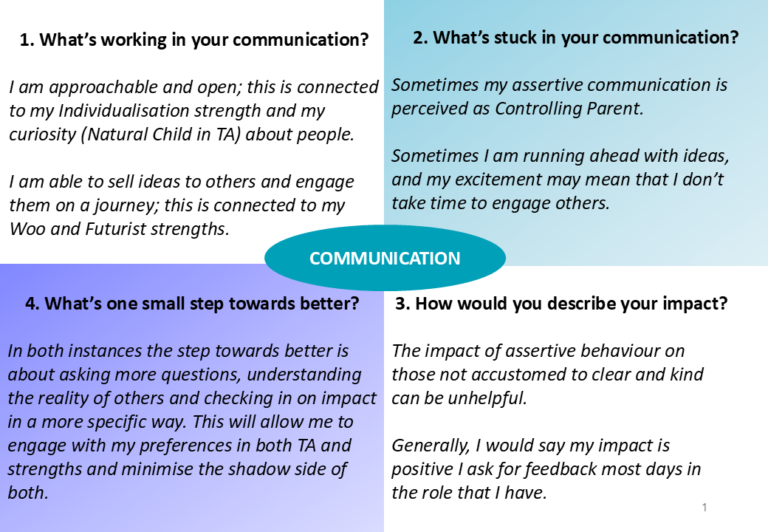
The WWG is a practical tool to take a snapshot in time of performance, behaviour, work planning or project planning. It starts by asking what is working and in this respect, it is connected to all of the thinking in ‘How Full is Your Bucket’ and to the idea of a strengths-based approach. There are numerous ways in which this can be used; the example below looks at communication. In this example, I have been honest and clear about my own communication and connected what works well to my Strengths and TA preferences whilst recognising what small steps of change I can make for me and my impact.
USING THE WWG TO PREPARE FOR ALS 1
In preparation for ALS 1, there are four tasks to complete. One of these requires action from your line manager, so please create time to prepare well.
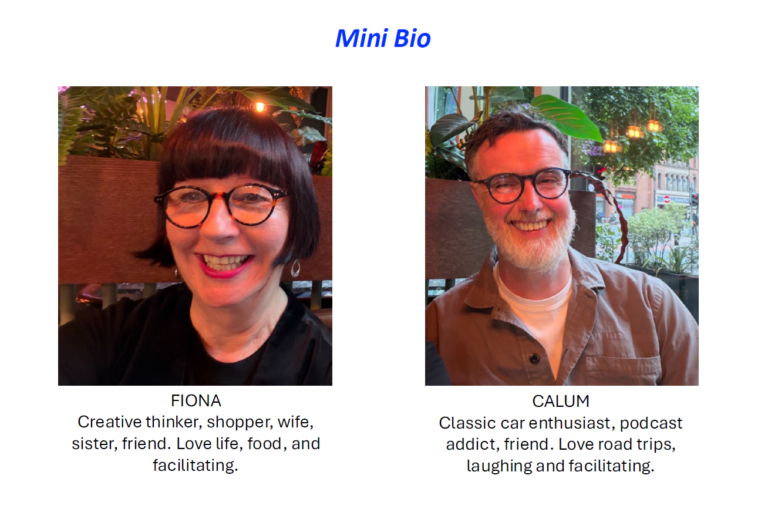
TASK 1: Complete a mini bio to share with your ALS colleagues. Keep it light and fun. No need to have a picture if you don’t want to. Here’s Calum and I below!
TASK 2: Watch this short video on reflective practice and make some notes about your thinking after you have watched it.
TASK 3: Reflect on the example of my Communication WWG shown above and complete your own for where you are.
TASK 4: Complete the Strengths WWG. Ask your line manager to complete the Line Manager version and have a conversation about what you have found out.
Downloads
ALS 2
THINKING ABOUT YOUR INFLUENCE AND IMPACT IN THE TEAM AND WIDER
Every single team member wields massive influence over overall success. Even without formal authority, individuals shape team dynamics by building trust, sharing information, modelling speaking-up behaviour, and taking ownership of specialised tasks. This personal engagement or disengagement directly dictates a team’s culture and output.
How Full is Your Bucket outlined the impact of negativity and positivity on health and well-being, collaboration, and good team working. We all know that the behaviour of others, their stress levels, and verbal and nonverbal communication influence the emotional temperature and our own behaviour. We know that when one person asks for help or admits a mistake, and that is well managed, that it makes it safe for others to do the same. Team members also hold power connected to their knowledge and they can use this to engage others.
This part of the programme provides an opportunity for you to reflect on how you influence and where you would like to influence more effectively.
PREPARING TO ATTEND ALS 2
In preparation for ALS, 2 there are two tasks to complete. One of these requires action from your line manager, so please create time to prepare thoroughly.
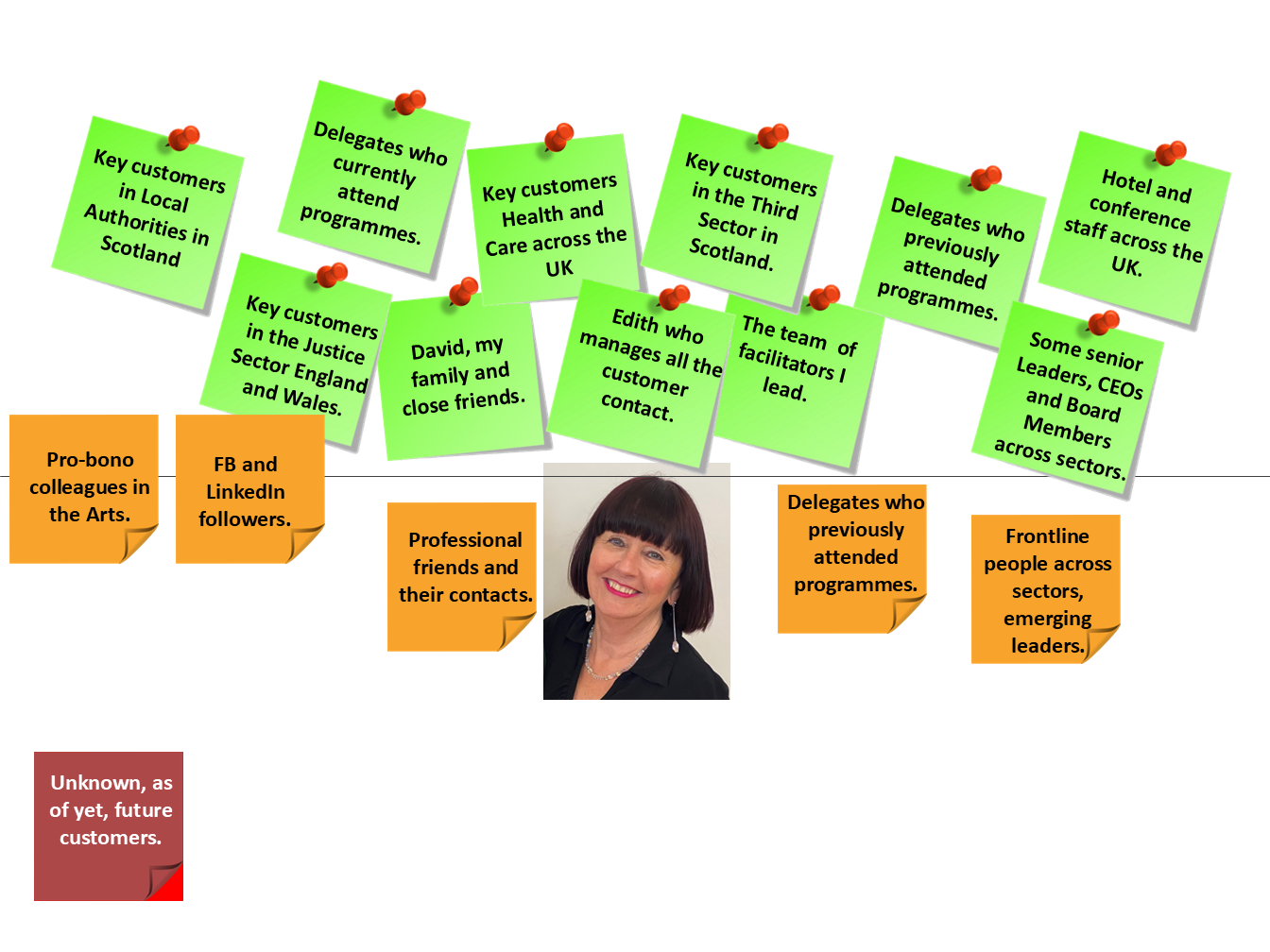
Listen to Fiona talking about her Map of Influence and why she thinks this is a helpful thing to create.
TASK 1: Complete a mini map of influence.
- Put yourself in the middle and then think about who you have influence with in green, closest to you.
- Put who you could have influence with, in orange.
- Finally, map those you believe you don’t need to have influence with, in red.
- Make some notes on what you have learned as a result of doing this and have a conversation with your line manager, do they have anything to add?
TASK 2: Download and complete the Push-Me/Pull-Me influencing questionnaire. And reflect on the following questions:
- What have you discovered about your influence from completing the Push Me/Pull Me assessment?
- Download the reflection sheet to join the dots with your TA and Strengths
- How can you use what you have learned to develop your Map of Influence?
ALS 3
CRYSTALLISING LEARNING
The final part of your Personal Leadership Programme is to crystallise your learning. This is an opportunity to reflect on the last 6 months and think about what has changed for you in terms of your thinking and behaviour, and how this work has supported you in your role as a critical team member in contributing to cultural change.
There are two specific tasks to complete for this ALS:
TASK 1: Appreciative Inquiry with your line manager.
Questions
- When you think about my strengths as a team member, what comes to mind?
- How do you see my role making a difference to the team?
- In your view, in the context of my impact, what do I need to let go of, and what do I need to learn?
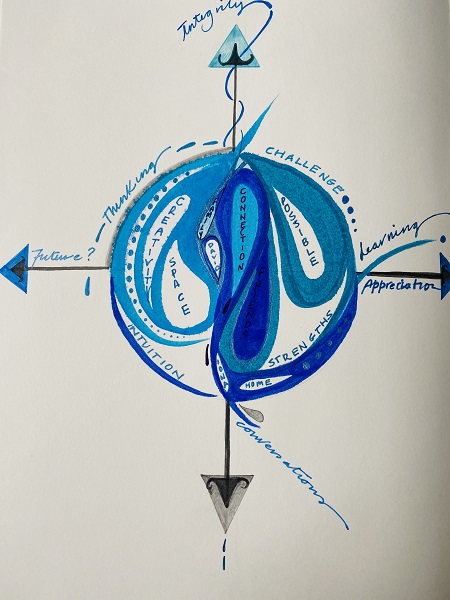
TASK 2: Creating your Personal Leadership Compass
Guidance
There is no time limit on this. You might make a start and come back to it later; it is your choice.
The Leadership Compass is an invitation into a safe, creative space. What follows is guidance, not a process or set of rules, more like some tips and thoughts. I have provided you with my compass and its story on the following pages in the spirit of shared learning, not as an exemplar.
Create your compass in whatever size you like, as long as it can be photographed and read as part of a collective artefact. As a rule of thumb, I would say no smaller than A4.
One person who loved scrap metal built something; another baked a cake! It’s the making that matters. A collage, drawing, sewing, whatever! Just manifest your thinking in a visual way. The only rule is no PowerPoint and no computer-generated images!
Questions that could help:
- How do you ‘show-up’ as a team player in your whole life?
- Who and what keeps you grounded?
- How does your significant learning from this programme impact your sense of direction for the future?
- What values guide you?
- What would you like your colleagues to remember you for?